Earlier this month, my husband and I spent a day in the beautiful countryside of West Berkshire, meeting up with Jill Saint – the daughter of Dora Saint who wrote as ‘Miss Read’. It’s no secret that I’m a huge Miss Read fan and this visit promised to be something very special indeed.
We met Jill in Chieveley – the village where Dora lived after the war – and, after a fine lunch at the local pub, the dark sky that had been glowering at us on our journey from Suffolk cleared to become a perfect Miss Read ‘blue and white day’.
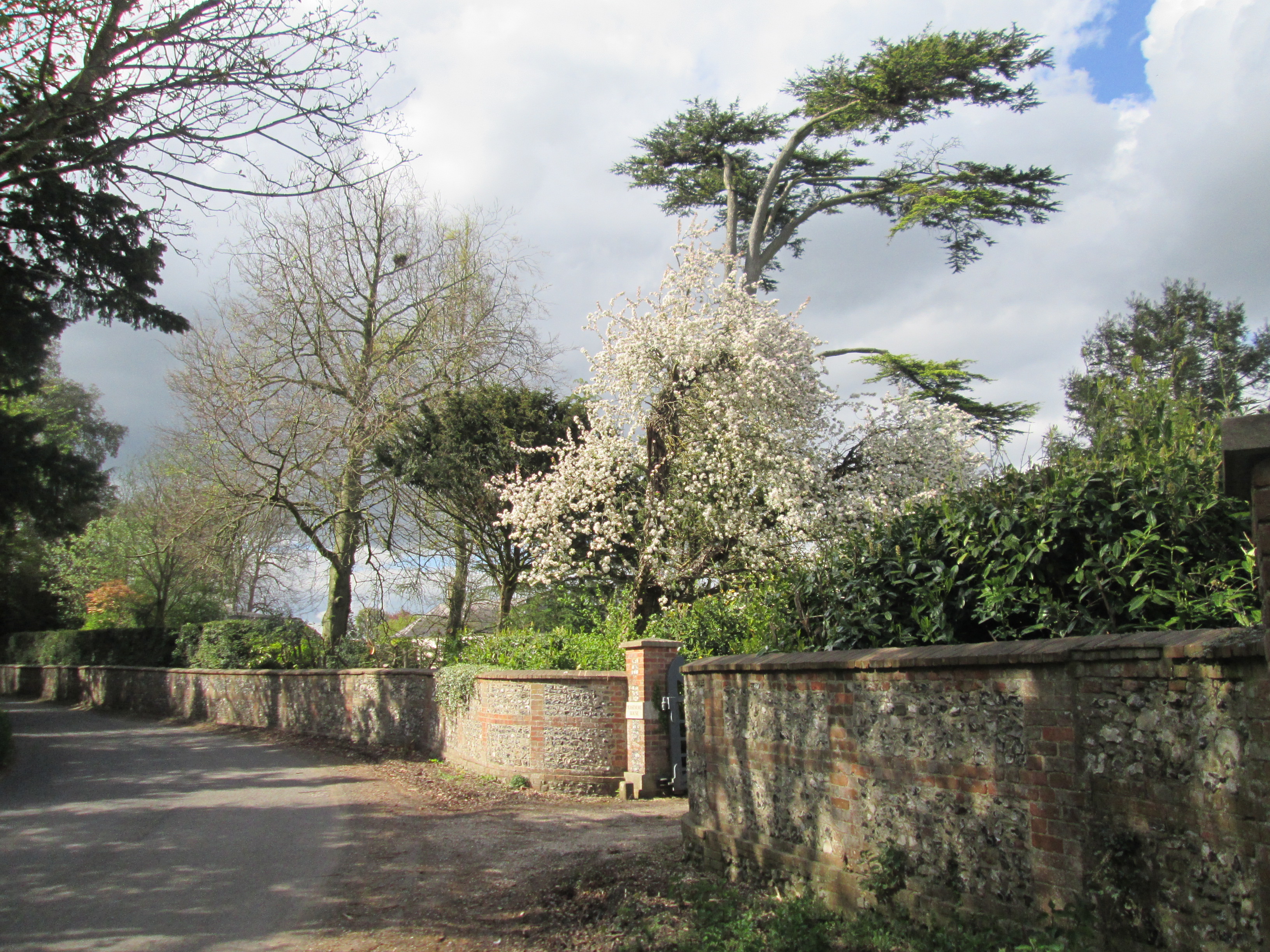
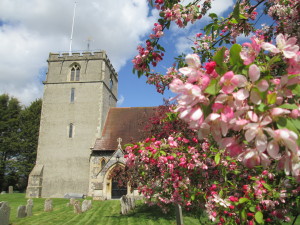 There is a very pretty churchyard at Chieveley and the blossom was out and there were cowslips and buttercups everywhere. The village gardens were all bursting with bluebells and wisteria, and Jill pointed out the pretty cottage where she lived with her parents for many happy years.
 A short car ride took us down the country lanes leading between Chieveley and Peasemore, the exact route Dora Saint would have ridden on her bicycle when supply teaching at the primary school.

 We parked by the village church which looked like something out of a J S Goodall illustration with its proud tower and steeple.
 And the village school where Dora Saint taught was just behind it. It’s a private home now, but you can still see the school bell and imagine the children laughing and playing ‘splash ’em’ in the playground just as they did in the Fairacre novels.
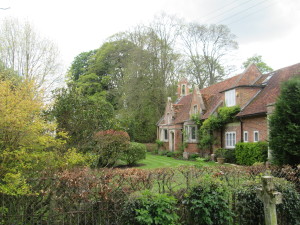 It was then a short walk to a very special place: a long brick and flint wall…
 But it wasn’t just any wall. This was the wall which readers might remember from a story called The Lucky Hole. Published in The Observer in 1953 and included in the collection Tales from a Village School and the recently published Mrs Griffin Sends Her Love, The Lucky Hole tells of the custom to leave small items like a coin or a sweet in a hole in the long flint wall for the local children to find. It was this story which caught the eye of publisher Robert Lusty at Michael Joseph Ltd, and he was the one who encouraged Dora to write her very first novel, Village School.
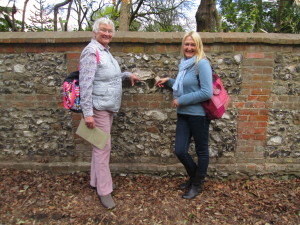 I love how this humble hole in the wall inspired a short story that then led to a book deal and one of the loveliest series ever written. I adore the Fairacre series and I feel truly thankful to this wall for leading to its creation.
Unlike Miss Read’s ‘Thrush Green’ which was based on Wood Green near Witney in Oxfordshire, Fairacre isn’t based on one particular village. However, I felt as if I’d found a little piece of Fairacre in Peasemore that day.
 And, of course, you can’t visit the lucky hole without leaving a little something inside it. I wonder how long it will be before the next visitor finds it …